
Is your car’s AC just not hitting the way it used to? Maybe it’s blowing lukewarm air, maybe it’s making a weird clicking noise, or maybe you’re just curious what’s actually going on behind that dashboard vent every time you crank it up.
These are the most common questions we get from customers before they even book a repair. And here’s the thing: not all car AC systems are built the same.
The type of system in your car affects how it’s diagnosed, what parts it needs, and yes, how much you’ll pay to fix it. Before you book a repair, it helps to know exactly what kind of system you’re dealing with.
How Every Car AC System Works
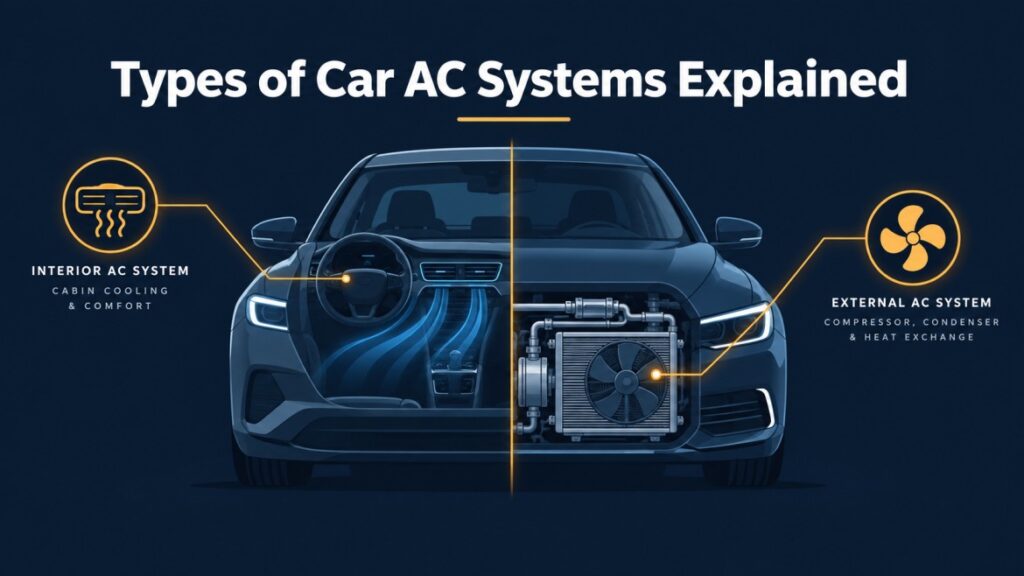
No matter what type of AC your car has, they’re all built on the same core idea: moving heat out of your cabin, not “creating” cold air out of nowhere.
The Vapor-Compression Cycle in 5 Steps
Here’s the short version of what’s happening every time you hit that AC button:
The compressor squeezes refrigerant gas, raising its pressure and temperature. The condenser (up front, near your radiator) releases that heat into outside air, turning the gas into a liquid. The metering device creates a sudden pressure drop, cooling the liquid refrigerant dramatically. The evaporator (inside your dash) absorbs heat from cabin air as the refrigerant evaporates back into gas. The cycle repeats, continuously pulling heat out of your car and dumping it outside.
Any breakdown along this loop, whether it’s a worn-out compressor or a clogged condenser, is usually fixed with a car AC compressor repair or a car AC condenser repair, depending on where the fault is.
Key Components: Compressor, Condenser, Evaporator, and More
Every system also includes a drier or accumulator to keep moisture out of the loop, hoses and seals to keep everything pressurized, and a control system (manual or computerized) that decides how hard everything works. The differences between types of car AC systems mostly come down to variations on these same parts. For a closer look at each one, see our full guide to car AC components.
Understanding how car AC works in depth can help you identify common problems, maintain the system properly, and know when professional repairs are needed.
Types of Car AC Systems by Refrigerant Loop Design
This is the split that matters most to a technician, and it comes down to one question: how does your car meter the refrigerant flow?
Thermal Expansion Valve (TXV) Systems
TXV systems use a precision valve that adjusts refrigerant flow in real time based on temperature. They pair with a receiver-drier sitting on the high-pressure side of the loop. Most European, Japanese, and modern vehicles use this setup because it delivers smoother, more responsive cooling.
Orifice Tube Systems
These use a simple fixed-size restriction instead of an adjustable valve. Since the flow can’t change, the compressor itself cycles on and off to regulate temperature. Orifice tube systems pair with an accumulator on the low-pressure side. This design has historically been common on domestic US vehicles like GM, Ford, and Chrysler.

How to Tell Which One Your Car Has
Look at the canister in your AC lines. If it’s mounted near the condenser on the high-pressure side, you’ve got a receiver-drier (TXV system). If it’s closer to the compressor on the low-pressure side, that’s an accumulator (orifice tube system). If you still can’t figure it out, our qualified car AC mechanics at 800CoolCar can identify it in minutes.
Types of Car AC Systems by Control Interface
Manual AC Systems
This is the classic setup: three dials for temperature, fan speed, and airflow direction. You set it, and it stays that way until you change it. It’s simple, affordable, and genuinely reliable, which is exactly why a good chunk of new vehicles still come with it.
Automatic Climate Control (Single, Dual, Tri & Quad-Zone)
Automatic systems use sensors to constantly monitor cabin and outside temperature, then adjust fan speed and airflow automatically to hold a set target. Depending on the vehicle, this can be:
- Single-zone — one setting for the whole cabin
- Dual-zone — separate driver and passenger settings
- Tri-zone — adds a rear-seat zone
- Quad-zone — independent controls for rear-left and rear-right passengers
Which Is More Expensive to Repair?
Automatic systems have more sensors, actuators, and control modules, which means more potential points of failure and higher diagnostic and repair costs compared to manual setups. That said, they’re also far more comfortable on long drives, so it’s a genuine trade-off.
Types of AC Compressors
The compressor is the heart of the system, and it gets classified two different ways.
Fixed vs. Variable Displacement Compressors
A fixed-displacement compressor runs at full output whenever it’s engaged, cycling on and off via a clutch. A variable-displacement compressor adjusts its own output continuously to match demand, which means smoother cooling, no evaporator frosting, and noticeably better fuel economy.
Piston, Wobble-Plate, Rotary Vane, and Scroll Compressors
Mechanically, compressors also come in a few different builds:
- Piston (swash-plate) — compact and widely used, works well with fixed or variable displacement
- Wobble-plate — a common mechanism behind variable-displacement designs
- Rotary vane — smoother, more continuous compression, but vanes can wear over time
- Scroll — quiet, low-vibration, and the go-to choice for electric compressors in hybrids and EVs
Belt-Driven vs. Electric Compressors
Belt-driven compressors run off the engine and only work while the engine is running. Electric compressors are powered by a separate motor, run independently of engine speed, and are now standard in hybrids and EVs, which is exactly why your neighbor’s Prius can still blast AC while sitting silently at a red light.
Types of Car AC Systems by Refrigerant
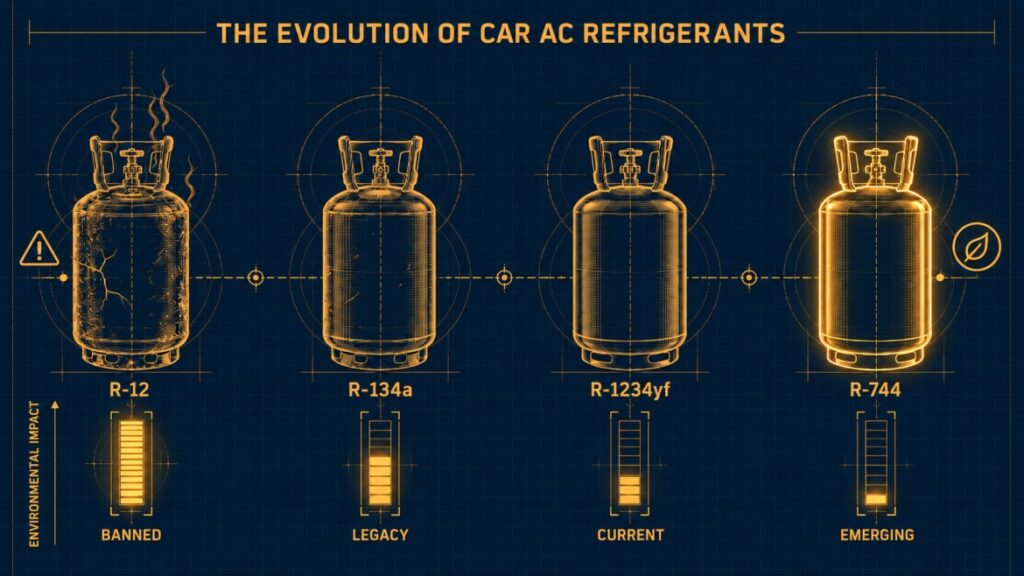
R-134a (Legacy Systems)
The industry standard from the mid-1990s through the 2010s. It’s still widely serviced today, but it’s gradually being phased out due to its environmental impact.
R-1234yf (Today’s Standard)
This is what almost every new car uses now. It has a dramatically lower environmental impact than R-134a, though it costs more and requires slightly different handling due to mild flammability. If your car was built in the last several years, this is very likely what’s running through your AC lines.
R-744/CO2 (Emerging Technology)
A newer, niche option used mainly in certain European EVs. It runs at much higher pressures than traditional systems, requiring specialized tools and components.
How to Find Out What Refrigerant Your Car Uses
Check the sticker under your hood, usually near the radiator support. It’ll list the exact refrigerant type your system was designed for — always confirm this before booking a car AC gas refill or repair.
AC Systems in Hybrid and Electric Vehicles
Why EVs Need Different AC Technology
Without a constantly running engine, EVs and hybrids can’t rely on engine heat or a belt-driven compressor. That means the entire AC (and heating) system has to run independently, off the battery.
PTC Heaters vs. Heat Pumps
PTC resistive heaters generate heat electrically, but they draw a lot of power, which can noticeably shrink your driving range in cold weather.
Heat pumps move existing heat around instead of generating it from scratch, using far less energy in the process. Cars with heat pumps tend to retain significantly more range in cold weather than those without it.
Common Signs Your AC System Needs Repair
- Warm air coming from vents — often a refrigerant, compressor, or electrical issue
- Strange noises or smells — clicking, grinding, or musty odors usually point to a failing compressor or mold in the evaporator, which a car AC cleaning service can resolve
- Refrigerant leaks and low cooling power — inconsistent cooling or visible residue near AC lines is a clear sign something’s leaking
When to Call a Professional vs. DIY Fixes
Topping off refrigerant with a store-bought can might buy you a little time, but it won’t fix a leak, a failing compressor, or electrical faults, and on newer systems (especially R-1234yf or EV setups), DIY work can even be unsafe. If your AC isn’t cooling properly, it’s worth having a professional diagnose the actual cause.
FAQ
How do I know what type of AC system my car has? Check your owner’s manual or the underhood refrigerant sticker, or ask your mechanic to identify the loop design (TXV vs. orifice tube) during an inspection.
Is R-1234yf more expensive to service than R-134a? Yes, generally. R-1234yf costs more per pound and may require specialized handling equipment, which can raise service costs compared to older R-134a systems.
Can I convert my car to a different refrigerant? Not without changing key system components. Refrigerants aren’t interchangeable, and doing this incorrectly can damage your AC system.
Do electric cars need AC recharges too? Yes. EV AC systems still use refrigerant and can develop leaks or component failures just like traditional systems — they just require technicians trained on high-voltage components.
Ready for a Cooler Ride?
Whether your car runs on a decades-old R-134a system or a brand-new EV heat pump, keeping your AC in good shape comes down to knowing what you’re working with, and catching problems early. If your AC isn’t performing the way it should, don’t wait for it to get worse. Book an inspection with a shop that knows the difference between these systems, and get back to driving in comfort.