
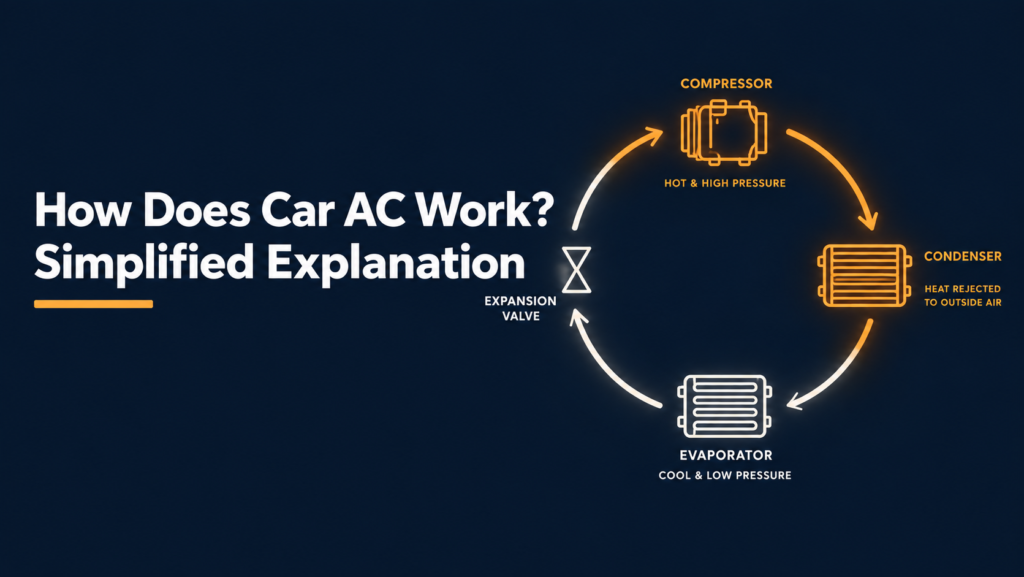
You get into a hot car, turn on the AC, and within a minute or two, cool air is blowing on your face. It feels like magic, but it’s not. Your car’s AC is running a clever, repeating cycle that moves heat out of your cabin and dumps it outside.
Here’s what’s actually happening under the hood, from the compressor to the cold air hitting your face.
The Basic Principle of Car AC Cooling
Here’s the part most people get wrong: your car’s AC doesn’t create cold air out of thin air. It pulls heat out of the air inside your cabin and pushes that heat outside your car.
Think about how sweat cools your skin. As it evaporates, it pulls heat away from your body, leaving you feeling cooler. Your car’s AC works on the same idea, just with a special fluid instead of sweat, and a sealed system instead of open air.
That fluid is called refrigerant, and it does almost all the work.
What Is Refrigerant?
Refrigerant is a chemical fluid with one very useful trick: it can switch between a liquid and a gas at low temperatures. Every time it switches, it either soaks up heat or lets heat go.
Most cars on the road today use a refrigerant called R-134a. Newer models are switching to R-1234yf, a version that’s easier on the environment. Older cars, especially anything before the mid-1990s, used R-12, better known as Freon, which was phased out for damaging the ozone layer.
Whichever type your car uses, the job is the same: grab heat from inside your cabin, then let it go outside.
The Car AC Cooling Cycle
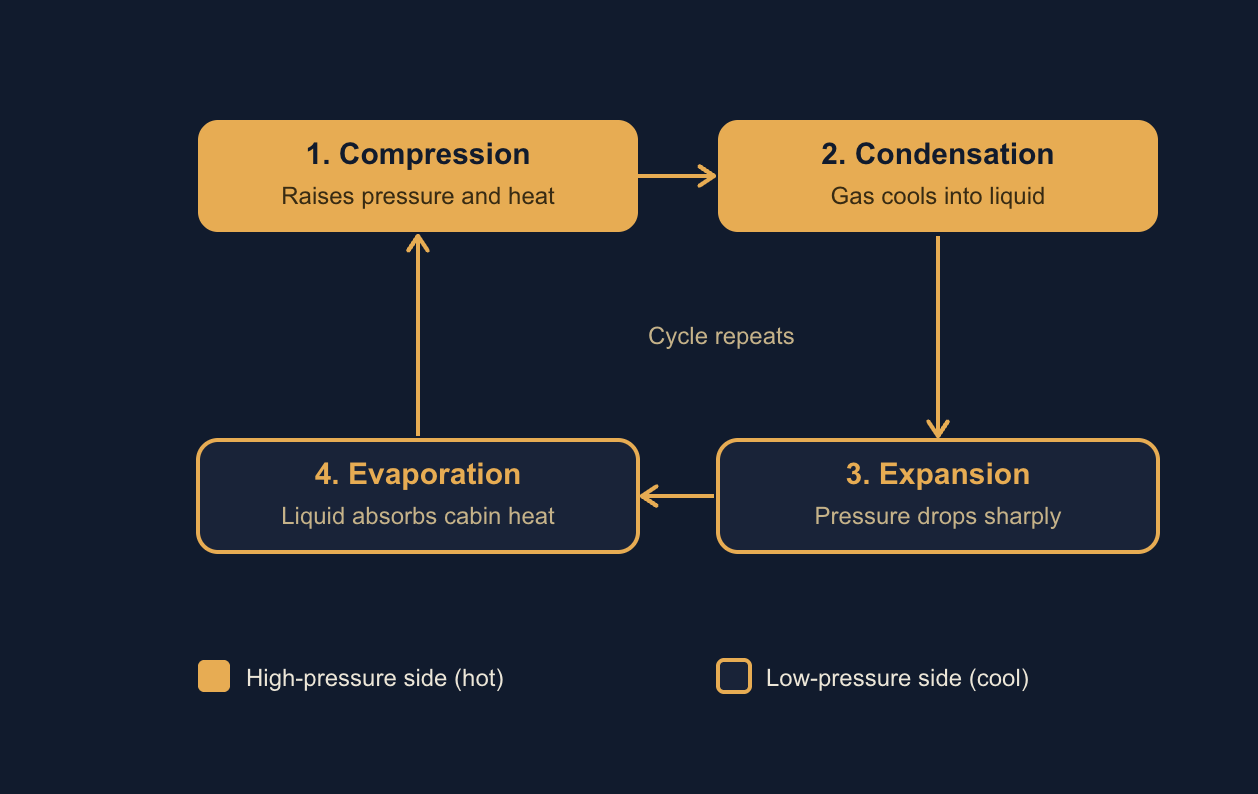
This is the part that actually cools your car. Refrigerant cycles through four stages, again and again, for as long as your AC is on.
Stage One: Compression
Everything begins at the compressor. Low-pressure refrigerant gas goes in, and the compressor squeezes it tight, which shoots up both its pressure and temperature. It comes out the other side as a hot, high-pressure gas. A weak or failing compressor is one of the most common reasons a car AC compressor repair gets booked.
Stage Two: Condensation
That hot gas moves into the condenser, sitting right at the front of your car. Outside air flows through it and carries the heat away. As the gas cools down, it turns into a high-pressure liquid, the same way steam turns back into water once it loses enough heat. A blocked or damaged condenser is a common reason people need a car AC condenser repair.
Stage Three: Expansion
The liquid then squeezes through a tiny restriction, either an expansion valve or an orifice tube, depending on your car. This causes the pressure to fall suddenly, and the temperature drops right along with it. What comes out is a cold, low-pressure liquid.
Stage Four: Evaporation
That cold refrigerant reaches the evaporator, tucked inside your dashboard. Warm cabin air blows across it, the refrigerant soaks up that heat and turns back into a gas, and the now-cool air gets pushed into your cabin by the blower motor. The refrigerant heads back to the compressor, and the whole thing starts over.
This loop just keeps repeating, which is why your AC keeps blowing cold the entire time it’s running.
Types of Car AC Systems
Some cars pair an expansion valve with a receiver-drier. Others use an orifice tube with an accumulator. Both get the job done, just with slightly different hardware. We break down the differences and which cars use which, in a separate guide on car AC system types.
Fresh Air Mode vs. Recirculation Mode
Most cars let you pick between fresh air mode and recirculation mode, and the difference actually matters on a hot day.
Fresh air mode keeps pulling in outside air, which is great for keeping the cabin air fresh, but it also means your AC keeps having to cool new, hot air over and over. Recirculation mode reuses the air that’s already inside your cabin, which is already cooler than the outside air, so your AC can cool it down much faster.
If your car feels like an oven when you first get in, switch to recirculate for the first few minutes. You’ll feel the difference.
What Causes the AC Cycle to Break Down?
Since the whole system depends on refrigerant flowing through a sealed loop, any leak, blockage, or worn-out part can throw the cycle off. Low refrigerant from a leak, usually resolved with a car AC gas refill; a blocked condenser, often fixed with a car AC condenser cleaning; or a failing compressor are the usual suspects. If your AC is blowing warm air or making odd noises, one of the four steps above isn’t happening the way it should.
FAQs
Does running the AC use more fuel? A little bit, yes. The compressor is powered by your engine through a belt, so running the AC adds a small extra load, which burns slightly more fuel.
Can the AC run with the engine off? Not in most cars. The compressor needs power from the engine to do its job. Some electric and hybrid vehicles are the exception, since they use an electric compressor instead.
Why does it take a few minutes to feel cold? The system needs a little time to pull the built-up heat out of a hot cabin and off the car ac components themselves. Switching to recirculate can speed this up.
Is R-1234yf actually better than R-134a? Yes. It breaks down faster once it’s in the atmosphere and has a much smaller impact on global warming, which is why manufacturers are gradually making the switch. Ask about it during your next car AC gas refill.
If your car’s AC isn’t completing this cycle the way it should, whether it’s a leak, a tired compressor, or a blocked condenser, our technicians can find the exact step that’s failing and fix it. Schedule a diagnostic with us today.