

Your car’s air conditioner is not one big machine. It’s a team of small parts working together. Each part has its own job. If even one part fails, your AC can stop blowing cold air, make strange noises, or start to smell bad.
In this guide, we’ll break down the 9 main car AC components in simple words. You’ll learn what each part does, where it sits in your car, and why it matters. By the end, you’ll understand your car’s cooling system well enough to talk to your mechanic with confidence.
How Many Parts Are in a Car AC System?
Most car AC systems have around 8 to 9 core components. These parts work together in a loop. They move refrigerant around your car to pull heat out of the cabin and push it outside.
Here’s a quick look at the parts we’ll cover:
- Refrigerant
- Compressor
- Condenser
- Receiver-drier or accumulator
- Expansion valve or orifice tube
- Evaporator
- Blower motor
- HVAC controls
- Cabin air filter
A quick note before we start: not every car uses the exact same setup. Some cars use an expansion valve with a receiver-drier. Others use an orifice tube with an accumulator. Both do the same basic job, just in slightly different ways. We’ll explain this as we go.
The 9 Main Car AC Components (And What Each One Does)
1. Refrigerant
Refrigerant is the fluid that makes your AC work. It’s a special chemical that can change from liquid to gas and back again. As it changes state, it absorbs heat from inside your car and releases it outside.
Older cars used a refrigerant called R-12, also known as Freon. It was phased out because it damaged the ozone layer. Most cars today use R-134a, and newer models are switching to R-1234yf, which is better for the environment.
If your AC stops cooling well, low refrigerant is often one of the first things a mechanic checks.
2. Compressor
The compressor is often called the heart of the AC system. It’s usually mounted near the engine and is driven by a belt.
Its job is simple but important: it pulls in low-pressure refrigerant gas and squeezes it into high-pressure, high-temperature gas. This pressurized gas then moves on to the condenser. Without a working compressor, your AC cannot cool the air at all.
3. Condenser
The condenser sits at the front of your car, usually right behind the grille, like a mini radiator.
When the hot, high-pressure gas from the compressor reaches the condenser, outside air flows through it and pulls the heat away. This cools the gas down and turns it back into a liquid. If the condenser gets blocked by dirt, bugs, or road debris, your AC’s cooling power can drop.
4. Receiver-Drier or Accumulator
This part removes moisture and dirt from the refrigerant before it can cause damage.
- A receiver-drier is used in systems that have an expansion valve. It sits on the high-pressure side of the system.
- An accumulator is used in systems that have an orifice tube. It sits on the low-pressure side, right before the compressor.
Both parts use a drying material called a desiccant to soak up moisture. This step matters a lot because moisture inside the AC system can freeze, cause rust, or damage the compressor over time.
5. Expansion Valve or Orifice Tube
This is where the refrigerant’s pressure drops sharply.
- The expansion valve adjusts refrigerant flow based on the current temperature and pressure. It’s the more precise option.
- The orifice tube is a simple fixed-size tube that always restricts flow by the same amount.
Either way, the job is the same: turn the high-pressure liquid refrigerant into a low-pressure liquid that’s ready to absorb heat in the next step.
6. Evaporator
The evaporator is the only AC part that sits inside your car’s cabin, usually tucked behind the dashboard.
As the low-pressure refrigerant flows through the evaporator, it absorbs heat from the cabin air and turns into a gas. This is the exact moment your car’s air actually gets cold. The now-warm refrigerant gas heads back to the compressor, and the whole cycle starts again.
7. Blower Motor
The blower motor is the fan that pushes the cooled air from the evaporator into your car’s cabin.
You control its speed using the fan setting on your dashboard. A weak or noisy blower motor is a common reason for poor airflow, even when the rest of the AC system is working fine.
8. HVAC Controls
These are the buttons, dials, or touchscreen settings you use every day. They let you choose the temperature, fan speed, and where the air comes out, like the vents, floor, or windshield.
On older cars, these controls are simple mechanical dials. On newer cars, they’re digital and can even set different temperatures for the driver and passenger sides.
9. Cabin Air Filter
The cabin air filter isn’t technically part of the cooling process, but it plays a big role in air quality. It’s usually located behind the glove box.
This filter traps dust, pollen, and other particles before they enter your car’s cabin. A dirty, clogged filter can reduce airflow from your vents and make your AC feel weaker than it actually is, even if every other part is working normally.
How These Parts Work Together
All 9 components work in one continuous loop. Refrigerant gets compressed, cooled, dried, depressurized, and finally used to absorb heat from your cabin, over and over, as long as your AC is running.
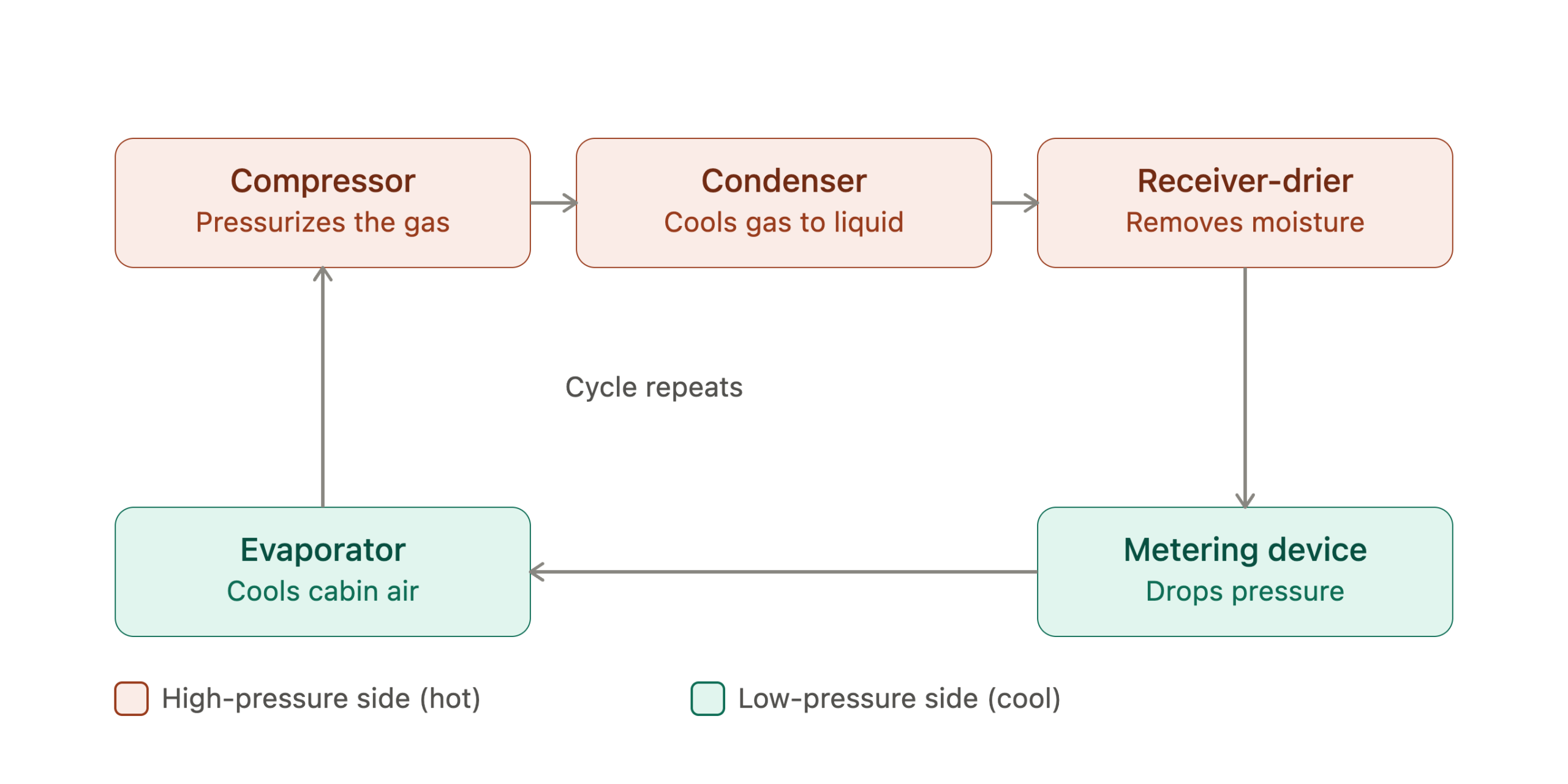
If you want a full breakdown of this cycle step by step, including the science behind why refrigerant cools your car, check out our detailed guide on how car AC actually works.
Signs One of These Components Might Be Failing
You don’t need to be a mechanic to notice when something’s wrong. Watch out for:
- Weak or warm airflow from the vents
- Strange noises like clicking, grinding, or hissing when the AC is on
- A musty or bad smell coming from the vents
- Visible oily residue near AC lines or connections, which can point to a leak
- The AC randomly turning on and off
Any of these signs usually means one of the 9 components above needs a closer look. If you notice any of them, it’s best to get your system checked before a small issue turns into a bigger, more expensive repair.
FAQs
What are the basic components of a car AC system?
The core components are the refrigerant, compressor, condenser, receiver-drier or accumulator, expansion valve or orifice tube, evaporator, blower motor, HVAC controls, and cabin air filter.
Which car AC component fails the most often?
The compressor and the condenser are two of the most common parts to fail, usually due to age, refrigerant leaks, or road debris damage.
Do all cars have the same AC components?
Most cars use the same basic parts, but the exact setup can differ. Some use an expansion valve and receiver-drier, while others use an orifice tube and accumulator.
What’s the difference between an accumulator and a receiver-drier?
Both remove moisture from the refrigerant, but they’re used in different systems and sit in different spots. A receiver-drier works with an expansion valve on the high-pressure side, while an accumulator works with an orifice tube on the low-pressure side.
Is refrigerant the same as Freon?
Freon is actually a brand name for R-12, an older type of refrigerant that is no longer used in modern cars. Today’s cars use R-134a or R-1234yf instead.
If your car’s AC isn’t cooling like it used to, our team can inspect every one of these components and get your system back to blowing cold air. Schedule a diagnostic with us today.